

AI Summary
The tourism sector is shifting to the experience economy. Lantern Festivals allow venues to transform ordinary spaces into profitable nighttime attractions. Strategic advantages include:
- Activating the nighttime economy.
- Increasing visitor dwell time.
- Adding interactive light festival features.
- Stabilizing off-peak revenue.
Introduction: The Shift Toward Experience-Led Consumption
In recent years, the global tourism and leisure industry has increasingly transitioned from a product- and service-based model toward what is widely recognized as the “experience economy.” In this framework, visitors are no longer satisfied with passive consumption; instead, they actively seek immersive, memorable, and emotionally engaging experiences.
For operators of theme parks, zoos, botanical gardens, cultural sites, and urban destinations, this shift has significant strategic implications. Traditional offerings—static exhibitions, daytime visits, and standard ticketing models—are no longer sufficient to sustain growth. Instead, success increasingly depends on the ability to design experiences that extend beyond the ordinary.
Within this context, Lantern Festivals have emerged as a highly effective experiential format. While often associated with traditional cultural celebrations, modern Lantern Festivals have evolved into scalable, commercially viable nighttime attractions. When complemented by elements commonly seen in Light Festivals, they become powerful tools for activating venues and aligning with the core principles of the experience economy.
1. The Experience Economy: A Practical Lens for Venue Operators
The concept of the experience economy, articulated by B. Joseph Pine II and James H. Gilmore, emphasizes that businesses must move beyond delivering services to staging experiences.
In the context of tourism, this translates into several key dynamics:
- Visitors prioritize emotional engagement and memory creation
- Time spent within a venue becomes a measurable value driver
- Social media amplification becomes an integral part of the product
- Seasonal and nighttime experiences gain increasing importance
For venue management, this means shifting focus from pure attendance metrics to a broader set of performance indicators, including dwell time, per capita spending, repeat visitation, and brand differentiation.
2. Why Lantern Festivals Align Naturally with the Experience Economy
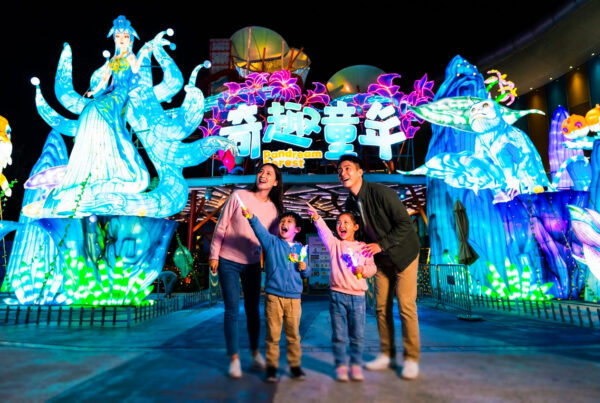
Lantern Festivals are particularly well-suited to the experience economy because they inherently combine visual impact, narrative storytelling, and spatial transformation.
2.1 Immersive Environmental Transformation
A Lantern Festival has the capacity to completely redefine a venue’s atmosphere:
- Landscapes are transformed into themed, illuminated environments
- Visitors move through curated storytelling zones rather than static exhibits
- The experience becomes sequential and exploratory
Unlike permanent attractions, these installations are temporary and adaptable, allowing venues to refresh content periodically without major capital expenditure.
2.2 Activation of Nighttime Economy
One of the most immediate advantages of Lantern Festivals is their ability to convert underutilized nighttime hours into revenue-generating opportunities:
- Daytime venues can operate dual ticketing models (day + night)
- Existing infrastructure is leveraged more efficiently
- New audience segments are introduced
In many cases, Lantern Festivals are complemented by Light Festival elements—such as projection mapping or interactive lighting—to further enhance the nighttime appeal.
2.3 High Emotional and Visual Engagement
Lantern Festivals are designed to evoke specific emotional responses:
- Wonder and immersion through large-scale illuminated sculptures
- Cultural curiosity through themed narratives
- Comfort and accessibility through walkable, family-friendly environments
This emotional layer is critical in the experience economy, where value is derived not just from what visitors see, but from how they feel.
3. Lantern Festival as a Core Product, Light Festival as a Complement
While Lantern Festivals can function as a standalone product, integrating selected Light Festival techniques can enhance their market competitiveness.
3.1 Lantern Festival as Narrative Infrastructure
Lantern Festivals typically provide:
- Strong thematic coherence (e.g., mythology, cultural stories, fantasy worlds)
- Physical structures that define visitor pathways
- A clear beginning, progression, and conclusion
This makes them particularly effective for family-oriented and culturally motivated audiences.
3.2 Light Festival Elements as Technological Enhancements
Light Festival components can be layered onto this foundation:
- Projection mapping to animate static lanterns
- Interactive lighting to increase visitor participation
- Dynamic color changes to introduce temporal variation
The result is a hybrid model where Lantern Festivals provide the structural and narrative backbone, while Light Festival techniques contribute interactivity and modernity.
4. Revenue Model Implications
From a commercial perspective, Lantern Festivals offer multiple revenue streams aligned with experience economy principles.
4.1 Ticketing Strategy
- Independent nighttime ticketing allows for incremental revenue
- Premium pricing is justified by uniqueness and limited-time availability
- Dynamic pricing can be applied based on demand cycles
4.2 Ancillary Revenue Opportunities
The immersive nature of Lantern Festivals encourages additional spending:
- Food and beverage offerings, often themed to match the festival
- Merchandise, including illuminated toys and souvenirs
- Optional add-ons such as VIP routes or guided experiences
4.3 Off-Season and Low-Utilization Periods
Lantern Festivals are particularly effective in:
- Winter or off-peak seasons
- Weekday evenings
- Transitional tourism periods
By filling these gaps, they improve overall asset utilization and stabilize revenue streams.
5. Audience Segmentation and Behavior
A well-designed Lantern Festival can appeal to multiple audience segments.
5.1 Family and Multi-Generational Visitors
Lantern Festivals are inherently accessible:
- Safe, structured environments
- Visual storytelling that does not rely on language
- Opportunities for shared family experiences
5.2 Social and Experience-Driven Audiences
When enhanced with Light Festival elements, the offering becomes more attractive to:
- Younger audiences seeking visually striking environments
- Couples and groups looking for social experiences
- Visitors motivated by content creation and sharing
5.3 Local vs. Tourist Markets
- Tourist-heavy destinations benefit from volume and seasonal peaks
- Local markets require repeatability and periodic content updates
This necessitates a strategy that balances novelty with operational efficiency.
6. Strategic Integration into Destination Development
Lantern Festivals deliver maximum value when integrated into broader destination strategies.
6.1 Brand Reinforcement
A Lantern Festival can reposition a venue as:
- Innovative and experience-driven
- Culturally rich and differentiated
- Seasonally dynamic
6.2 Ecosystem Collaboration
- Partnerships with tourism boards and municipalities
- Integration with hospitality and transport sectors
- Cross-promotion with nearby attractions
This expands the economic impact beyond the venue itself.
6.3 Scalability Across Locations
For operators managing multiple sites, Lantern Festivals offer:
- Replicable content frameworks
- Modular installation approaches
- Reduced creative risk compared to entirely new concepts
7. Operational Considerations
Despite their flexibility, Lantern Festivals require disciplined execution.
7.1 Visitor Flow and Safety
- Clear routing and signage are essential in low-light conditions
- Crowd density must be actively managed
- Emergency access and evacuation planning are critical
7.2 Technical and Maintenance Requirements
- Lighting systems must be robust and weather-resistant
- Daily inspections and rapid maintenance protocols are necessary
- Power infrastructure must be reliable and scalable
7.3 Regulatory Compliance
- Fire safety and electrical standards must be strictly adhered to
- Local regulations may vary depending on installation scale and duration
8. Future Outlook: Lantern Festivals in a Maturing Experience Economy
Several long-term trends support the continued growth of Lantern Festivals:
- Increasing demand for immersive, out-of-home experiences
- Expansion of nighttime economies in urban planning
- Rising importance of social media-driven visibility
- Need for flexible, lower-capex attraction models
As the experience economy matures, Lantern Festivals—augmented by Light Festival technologies—are likely to become a standard tool in the strategic toolkit of venue operators.
Conclusion
Lantern Festivals represent a structured, scalable response to the demands of the experience economy. By transforming physical spaces into immersive environments, extending operational hours, and creating emotionally resonant experiences, they enable venues to unlock new revenue streams and strengthen their market positioning.
When thoughtfully integrated with selected Light Festival elements, Lantern Festivals evolve from cultural displays into comprehensive experiential platforms. For decision-makers in the tourism and leisure sector, they offer a practical, adaptable, and commercially viable pathway to sustained growth in an increasingly experience-driven market.